40 Years, 26 Lessons: How to Outsmart the Machines and Own Your Future in 2026
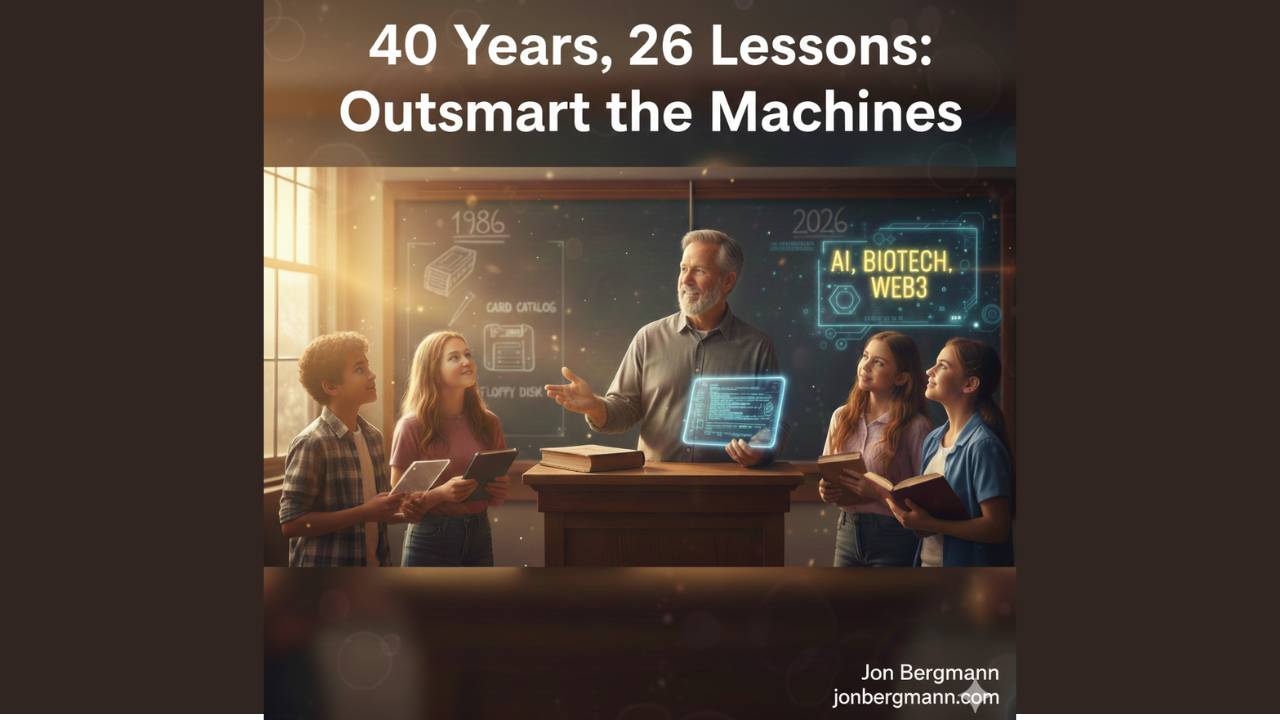
This is my 40th year in education, and I have seen it all. When I started teaching in 1986, there were no computers; I calculated grades by hand, learned from physical books, and looked things up in the card catalog.
I have lived a deep and fulfilling life, and I hope I have inspired others to live well. I find myself being more reflective as the months and years go by, and I think more about the future I want for my students. So, as one of the “old” teachers, here are 26 pieces of advice I have for students as we start out 2026. If you only have time for one, skip to #15—it’s the lesson that changed my life more than any other."
Phase 1: Mastering the Craft (School & AI)
The tools have changed, but the way the brain learns has not.
1. Turn Struggle Into Strength.
“Most students think that if learning feels hard, something is wrong. I’ve watched this for decades: struggle is actually the part that matters.
In the early 2000’s, I had a student who was terrible at math — at least, that’s what she thought. She would get frustrated and shut down every time we tried something new. But I kept nudging her, letting her wrestle with the problems on her own before giving the answers. Slowly, bit by bit, she started to get it. That struggle, that wrestling with the material, was what made it stick.
The point is, growth almost never feels easy. The next time something feels hard, don’t panic. Stay with it a little longer than you want to. That uncomfortable spot? That’s where learning really happens. And if you stick with it, you’ll be surprised at just how strong you’ve become.”
2. Master Pre-Work Before You Show Up.
“One thing I’ve learned over the years is that showing up prepared makes all the difference. I remember when I started flipping my classroom — I asked students to watch a short video before class and come ready to solve problems. The ones who actually did the pre-work? They soared. The ones who skipped it? They struggled, frustrated, and often gave up.
The lesson is simple: doing the work ahead of time isn’t busywork. It’s the foundation. You can’t build a strong house on a shaky foundation, and you can’t build real understanding in class if you haven’t done the groundwork.
Start small. Watch that five-minute video, read that one page, or try that one problem before class. Then, when you show up, the real magic happens — the thinking, the practice, the discovery. That’s where learning sticks.”
3. Think First — Then Use AI
“When it comes to tools like AI, the order matters. In an open letter I wrote to my own students about navigating this era of AI, I quoted Scott Latham, a business professor who looked at how students used AI on their writing assignments.
He found something surprising: students who let AI write the rough draft first — and then tried to fix it — actually did worse. The quality of their work went down. But the students who wrote their own draft first, then used AI to refine and improve what they’d already done? Their work was far stronger.
That tells us something important — tools like AI should amplify your thinking, not replace it. So start with your own effort: write, brainstorm, puzzle through it yourself. Once you have that foundation, then let AI help you clarify, expand, and refine. That’s how you build real understanding and avoid shortchanging your own growth.”
4. Make Class Time Count—Stop the Waiting Room Game
Too many students treat the classroom like a waiting room—waiting for the bell to ring, for the weekend to start, or for a 'better time' to figure it out later with AI. But here’s the truth: Real learning doesn't wait.
When I started flipping my classroom, I realized that lectures belong at home, but the hard work belongs in class. Classroom time is precious because it's the only time you are surrounded by peers and a teacher who can help you wrestle with ideas.
If you coast through class thinking you’ll just 'catch up later,' you’re missing the struggle that actually builds your brain. The insights, the 'aha' moments, and the skills happen in the moment you engage. Put the phone away, lean in, and do the work now. Don't just sit there in the waiting room—start building your future while you're in the room
5. Ask Better Questions, Not Just Answers.
Are you a 'grade hound'? You might be winning the points game, but losing the learning game. Many students focus on getting points — chasing grades, quizzes, and homework scores. I call them “grade hounds.” They want the answer, the checkmark, the easy win. But here’s what I’ve learned in decades of teaching: those students rarely thrive long term.
The ones who do thrive? The students who ask questions. Even messy, imperfect ones. They lean into curiosity, explore ideas, and challenge themselves. That’s how real learning sticks.
When I flipped my classroom, I saw this clearly: students who asked, “Why does this work?” or “What if I try it differently?” not only understood the material better — they carried that curiosity into everything else they did. Answers fade. Curiosity lasts a lifetime.
So don’t chase points. Chase questions. Ask, explore, and wonder. That’s the path to real growth and long-term success.
6. Use Feedback to Guide Growth
One of the fastest ways to get better at anything is to pay attention to feedback. But most students hear it as criticism, not guidance. They get defensive or ignore it. That’s a mistake.
I remember when I was writing my last book. My editor cautiously told me she had something to say. I piped in, “Chapter 15?” She said yes. I knew it wasn’t my best writing. I had spent hours on it, but in the best interest of the book, I had to delete it. And she was right.
Feedback is a mirror — it shows you where you can improve. If a teacher points out a mistake, or a peer gives you an idea, don’t take it personally. Take it as a tool to get better.
Your growth works the same way. Embrace feedback, experiment, adjust, and keep moving forward. Every correction, suggestion, or critique is a step toward mastery. Don’t fear it — use it. That’s how real progress happens.
7. Build Strong Thinking Habits.
In five years, nobody will care about your GPA. But they will care about how you think. Grades and answers fade, but the way you train your brain lasts a lifetime. Strong thinking habits mean learning to analyze, question, and reason — not just memorize or copy.
Here’s a simple strategy: when you read something, ask yourself, “Do I really understand this? Could I explain it to someone else?” Even better, prepare for an oral test — imagine explaining the material to your teacher or a classmate. If you can teach it, you truly understand it.
When you solve a problem, don’t stop at the first answer. Ask, “Is there another way?” Think through different solutions. These habits train your mind to be creative, flexible, and independent.
I’ve seen students who practice these habits tackle challenges others avoid. They aren’t naturally smarter — they just know how to think well. Focus on how you think, not just what you do. Build your thinking habits now, and your future self will thank you.
8. Take Your Time — Mastery Over Speed
Here’s something I’ve learned after decades of teaching: it doesn’t matter when you learn something. What matters is that you actually learn it.
In my classroom, you get extra chances to show mastery — you can retake tests until the material sticks. But don’t mistake that for unlimited time. Life is busy — sports, clubs, jobs — it pulls you in a hundred directions.
The students who really succeed aren’t the ones rushing through tests to get a grade. They’re the ones who use their retake wisely, slow down, focus on understanding, and make the learning theirs.
Mastery isn’t a race. Take the time you have, do it right, and own what you learn. That’s the stuff that lasts.
Phase 2: Building the Person (Character & Resilience)
Who you are matters more than what you can do.
9. Believe You’re Capable
One of the biggest lies students tell themselves is, “I’m just not good at this.” I’ve heard it about math, writing, and school in general. And most of the time, it’s not ability that’s missing — it’s belief.
I learned this the hard way in my own life. Years ago, I was overweight and out of shape. Fitness was not my thing. But instead of deciding “this just isn’t who I am,” I took one small step and signed up for a short triathlon. I wasn’t good at it. Not even close. But I kept showing up.
Little by little, focusing on something I was bad at changed me. One step at a time turned into a healthier life. Eventually, I completed four Ironman triathlons, and I still do long-distance cycling today. Not because I was naturally gifted — but because I leaned into the struggle instead of running from it.
That’s how learning works too. You don’t start capable — you become capable. Confidence comes after effort, not before. So don’t decide too early who you are. Take the next small step, and then the next one. You are capable of far more than you think.
10. Live a Life of Reflection
Your life is moving at 2x speed. If you don’t hit pause, you’re just "downloading" information without ever "installing" it.
I’ve been journaling for over 40 years, and it changes me. I have an agreement with myself to be 100% honest in my journal, and it's often raw. I use it to argue with God, to lament, and to rejoice. My thoughts clear up, and as I write, my path forward reveals itself.
Reflection is looking at your mistakes and turning them into lessons. It’s where you look at your wins and turn them into confidence. Don't just go through life—grow through it.
The Challenge: Take 10 minutes tonight. Put the phone in another room, grab a notebook, and ask yourself: "What did I learn today? What mistakes did I make?" You might even use the time to write a letter to God. This small habit of reflection will set you up to live with purpose.
11. Small Habits Add Up
Do you want to know how a meaningful life is actually built? It’s not through big, dramatic moments — it’s through small habits done faithfully over time.
When I was 20 years old, I started journaling. I’m 62 now, and I journaled today. At the time, I had no idea that one small habit would eventually lead me to write 11 books, translated into 13 languages, especially coming from an average English student.
The habits you form now matter more than you think. We are habitual creatures. The question isn’t if you have habits — it’s whether those habits are shaping you or distracting you from your higher calling.
Start small. Put the phone down. Read a few pages. Do the assignment yourself instead of letting AI do the thinking. These little choices add up.
You were made for a purpose — not to be endlessly entertained, but to do meaningful work with your life.
12. Protect Your Thinking Time.
In today’s world, distractions are everywhere — apps, notifications, even AI doing your work for you. If you want to get ahead in school and life, you need to protect your thinking time.
For me, my best ideas come on a long walk or bike ride. That’s when my mind clears, connections click, and thoughts flow freely. Even 15 or 20 minutes of uninterrupted thinking can spark insights you wouldn’t get otherwise.
If you carve out this time, you’ll excel — you’ll ask smarter questions, solve tougher problems, and remember what you learn. Students who skip this step often rush, skim, or rely on shortcuts, and their understanding never sticks.
So guard your brain. Take a walk, sit quietly, or find a space to think deeply. That time is where real learning and real progress happen. Protect it like your future depends on it — because it does.
13. Don’t Aim for Perfect — Aim for Progress.
So many students get stuck chasing perfection. Every test, every lab, every assignment — it has to be flawless. But here’s the problem: perfection is a trap. It keeps you from learning deeply and moving forward.
I’ve seen students who study for hours but still bomb a test. Why? They try to memorize for the short term rather than really understand the material. They aim for “perfect recall” instead of building lasting knowledge. Real learning comes from practice, mistakes, and reflection — not from endless hours of surface-level memorization.
Think of progress as a ladder. Every small step — trying a problem, asking a question, reviewing a concept — moves you higher. Even if it’s not perfect, it’s moving you forward.
So stop aiming for perfection. Focus on learning a little deeper each time, improving with every attempt, and building knowledge that lasts. That’s how real progress and real success happen.
14. The High Road
If you do anything significant with your life, there will be opposition. Some people will say and do mean things to you. In that moment you have a choice. Do you lash back or do you let it bounce off of you? I have not done this perfectly, but I have found that when I take the high road and do the harder thing, things work out better for me and they will you too.
15. Choose to do the Hard Thing
Life is hard — and you get to choose your hard.
It’s hard to resist cheating on a test, but it’s even harder to live with the guilt. Choose your hard.
It’s hard to put down your phone, but it’s even harder when distractions steal your time and focus. Choose your hard.
It’s hard to ask for help, but it’s even harder to fall behind silently. Choose your hard.
It’s hard to be kind to someone who annoys you, but it’s even harder to lose a friend over pride. Choose your hard.
It’s hard to practice a skill or stick to healthy habits, but it’s even harder when opportunities pass you by. Choose your hard.
Life will always be challenging. The difference is in which challenges you pick. Choose the right hard — the one that builds you up.
16. Walk in Humility
In 40 years of teaching, I’ve seen thousands of students. And I’m going to tell you something that sounds wrong: You are not that big of a deal.
Hear me out. We live in a world that tells you to be your own biggest fan, to post every win, and to always be the 'main character.' But arrogance is actually a ceiling. It stops you from growing. Arrogance says: 'I already know everything.' Humility says: 'I’m a work in progress.'
When you walk in humility, you become coachable. You become the person people want to help. You become a leader whom others actually trust. Humility isn’t thinking less of yourself—it’s thinking of yourself less. It’s being willing to take the back seat so you can learn how the front seat actually works. It’s the superpower that lets you absorb wisdom while everyone else is busy talking.
17. It is more important to BE than to DO
You are not a human doing, you are a human being. I personally struggle with this concept. I am good at getting things done, but in the end, I was created to live as a child of a King, and nothing I can do, whether positive or negative, will change my assured relationship with my Creator. Live in such a way that you rest in the reality of His great care for you.
Phase 3: Connecting to the World (Relationships & Future)
You are part of something much bigger than yourself.
18. Practice Radical Gratitude
In a world designed to make you want "more," gratitude is the only thing that gives you "enough."
It is so easy to live a self-centered life. I owe so much to the people who changed my life—from my high school Chemistry teacher to my parents and my mentors. You also have people who have poured into your life. Go thank them. But radical gratitude goes beyond being thankful for the good things. It means being thankful for the challenges, too. Those struggles are the forge that will fashion you into a strong and resilient person. Without the heat of the forge, the metal never becomes a tool.
The Pro Tip: If you follow Tip #11 (Reflection), use that time to journal your gratitude. Writing down what you are grateful for—the wins and the weights—will sear those lessons into your mind and your soul.
19. Don't Swap Human Connection for a Simulation
Your phone is making you more 'connected,' but it’s actually making you worse at relationships. In an era of AI chatbots and social media feeds, it’s easy to settle for a simulation of friendship. You’ve likely seen those apps that promise to be your 'AI friend'—always available, always cheering you up. But here is the hard truth: An AI can simulate a conversation, but it cannot care about you.
Humans are made for real, messy, irreplaceable relationships—friends who challenge you, classmates who make you laugh, and mentors who push you to grow. I’ve watched students who rely too much on digital connections struggle with empathy, teamwork, and confidence.
Real connection requires being present. It’s asking a friend how their day went, joining a study group, or having a face-to-face conversation where you can't hit 'undo.' Don't drift away behind a screen. Invest in real people. Those human connections will shape your life in ways technology never can.
20. Live life with good people
There is an old adage that says you are the average of your five closest friends. It’s true. Surround yourself with quality people who will not only listen to you but also challenge you and push you to become better. When my own children were entering high school, I shared with them that the most important decision they would make would be who they would hang out with. This is my 40th year in education, and I can say that students who find a positive, encouraging friend group will thrive the most.
21. Find Mentors
You are young, and you need adults to guide you. I am fortunate in that when I was young, I found a few people who poured into my life. They believed I could be more than I was. I am not a self-made man. It is a lie that people are self-made. Those who make a big difference in the world always have those who push them and believe in them. We humans, are made to live in a society so go find your mentor - someone who has been there and done that. Your life will be forever changed.
22. Find a purpose.
Do you know your purpose? We, as humans, were designed to crave a sense of purpose. Even if you’re still figuring out who you are, you can choose to live intentionally. That means living each day with a longer perspective in mind.
A meaningful life isn’t built all at once. It’s built through small, daily choices — choosing the harder thing, choosing not to get distracted, choosing to befriend the kid who seems lonely, and choosing to pursue your Creator.
What I’ve learned over the years is that I’m most fulfilled when I live out of my deeper calling, when I live as if what I do truly matters — because it does. And don’t let anyone tell you that what you do doesn’t matter. It does.
23. Be Adaptable — The Future Will Change Again.
Life rarely goes according to plan. Schools change, friends change, interests change — and your future job or career will probably look nothing like you imagine.
The students who succeed aren’t always the smartest. They’re the ones who adapt, who try new approaches, learn from mistakes, and keep going when things don’t work out.
Think of change like a river. You can fight it and get stuck, or you can flow with it and use it to move forward. Flexibility, curiosity, and a willingness to pivot will keep you ahead no matter what comes next.
So don’t fear change. Practice adaptability now — take on challenges you wouldn’t normally try, adjust when things go wrong, and keep learning. The future will change again, and when it does, you’ll be ready.
24. Curiosity Is Your Best Habit.
In my life, curiosity has always been my guide. It’s what led me to explore new ideas, write books, and take paths I never imagined. When I see a genuinely curious student, something magical happens — they take off in ways that surprise everyone, including themselves.
Curiosity isn’t just asking questions because you have to; it’s wondering, exploring, and digging deeper than what’s required. It turns challenges into adventures and assignments into discoveries.
The students who just follow instructions might get by, but the curious ones? They grow faster, learn more, and open doors that others don’t even see.
So make curiosity your habit. Ask questions, explore ideas, read beyond the assignment, and don’t be afraid to be wrong. Curiosity isn’t just learning — it’s the habit that shapes your future.
25. Life is not about you.
It is so easy to think that the world revolves around me. But it doesn’t. I was not put here to be served, but to make a difference by serving others. Life is not about you. You need to reorder your life in such a way that you live for the benefit of others and our society.
26. Think Ahead—The Future Needs You
“You’re living in one of the most exciting eras in history — the Fourth Industrial Revolution. AI, biotechnology, and new technologies are changing everything around us, faster than anyone could have imagined.
That can feel overwhelming — jobs, industries, even school seem different. But here’s the truth: what will matter most is your ability to think, learn, and create. Machines can’t replace curiosity, deep understanding, or imagination.
So instead of worrying about the future, prepare for it. Ask questions, solve problems, challenge yourself, and build skills that last a lifetime. The opportunities are huge for the students who focus on thinking well, not just memorizing answers.
This isn’t a time to be afraid. It’s a time to step up, lean in, and get ready — because the world needs thinkers, makers, and learners. That’s your edge.”
The Challenge: Your Turn to Build
Forty years ago, I stood where you are now, looking out at a world that felt vast and unknown. Back then, we had card catalogs and handwritten ledgers. Today, you have the world’s information in your pocket and AI at your fingertips. The tools have changed, but the requirement for a life well-lived remains exactly the same.
The future isn’t something that just happens to you; it is something you build with every small choice, every wrestled-with math problem, and every act of humility.
So, here is my challenge to you for 2026: Don't just be a consumer of this new world—be a contributor to it. Don’t settle for the easy answer from a machine when you were designed for the deep satisfaction of the struggle. Choose your "hard." Guard your focus. Lean into the messy, beautiful reality of human connection.
I have spent four decades watching students realize they are capable of more than they ever dreamed. My time in the classroom will eventually come to an end, but your story is just beginning. Take these 26 lessons, not as rules to follow, but as a foundation to build upon.
The world is waiting for thinkers, for servants, and for leaders who know who they are. Go out and be one.
Jon's created several courses that will help you in the age of AI. Each short course will help you become a better teacher.